 Albania
 Bosnia and Herzegovina
 Bulgaria
 Croatia
 Cyprus
 Montenegro
 Czech Republic
 Denmark
 Estonia
 Spain
 Kosovo
 Lithuania
 Latvia
 Luxembourg
 Macedonia
 Germany
 Poland
 Portugal
 Romania
 Serbia
 Slovakia
 Slovenia
 Switzerland
 Sweden
 Turkey
 Hungary
 United Kingdom
 Italy
 UAE
 Hong Kong
 Kuwait
 Lebanon
 South Africa


Pregnant women's
zone
Coffee during pregnancy is a daily ritual that many moms-to-be do not want to give up, hence the question often comes from their side during one of the first visits to the gynecologist. Clinical studies have shown that 300 mg of caffeine is the maximum daily dose that expectant mothers can afford. It was unanimously agreed that this amount is safe for the baby while still in fetal life, as well as later – during breastfeeding. Are you sure? Which drinks can be drunk instead of coffee?
Why does coffee and the caffeine it contains have such beneficial effects?
Many people find coffee simply tasty and stimulates the body, making them unable to imagine starting their day without a tasty cappuccino or espresso. Coffee is widely believed to increase concentration, improve mood and reflexes. Caffeine also boosts metabolism, fights free radicals and increases heart rate. Unfortunately, but a substance like caffeine also has a downside. It impedes the absorption of the elements, i.e. calcium and iron, the lack of which is very troublesome for pregnant women.
Pregnancy and drinking coffee
Drinking coffee during pregnancy is not prohibited, although doctors’ opinions on the subject are divided. Clinical studies have shown that pregnant women must not exceed 300mg of caffeine in a daily dose. How many coffees during pregnancy can you drink in a day and which coffee during pregnancy will be appropriate? During the day you can drink two, maximum three cups of coffee of 100 ml each. It doesn’t matter what kind it is. It is important to drink coffee in moderation during pregnancy. The effects of excess caffeine can be tragic. It is one of the causes of miscarriages and malformations in the child.
Highly praised by moms-to-be is cereal coffee. It is 100% safe for the baby during pregnancy. It is a decaffeinated beverage, so it does not have the same effectiveness as regular coffee. During pregnancy, caffeinated coffee is recommended for low blood pressure. Cereal coffee can be drunk in principle without restriction. It contains soluble fiber, which facilitates intestinal peristalsis. It is helpful for constipation, which pregnant women complain of. The antioxidants in it reduce the effects of free radicals. In addition, it provides phosphorus, potassium and magnesium, whose levels are very important during pregnancy.
What can you drink instead of coffee during pregnancy? Properties similar to coffee are found in green tea. The stimulating effect from green tea lasts even longer than with the popular small black tea. This is an alternative for women who love coffee and have to give it up for the duration of pregnancy. Unfortunately, but drinking green tea is also subject to restrictions. The maximum amount is just two cups a day. More of this drink can interfere with the absorption of folic acid, and it is very important during pregnancy. Its sufficient quantity in the body of the mother-to-be determines the proper development of the child.
Drinking coffee and breastfeeding
Drinking coffee while breastfeeding is as safe as coffee during pregnancy. It is only necessary to exercise moderation, just as before childbirth. The toddler can’t get rid of caffeine from his body, so it accumulates in his tissues. Too much can cause him to have tummy aches, or anxiety. As a result, mom and baby may have sleepless nights. Stimulation does not serve the toddler. In the first months of life, a baby needs a lot of sleep.
The amount of caffeine in coffee is not always the same. Moms who drink coffee while breastfeeding should pay attention to the packaging and the caffeine content per cup of the beverage. They also need to remember that caffeine is also in food products. In which ones?
The caffeine content has:
- chocolate – bar
- sweet cocoa
- Coffee-flavored ice cream and yogurt
- stimulating energy drinks
- some soft drinks
- tea
- hot chocolate
- painkillers
Some foods contain as much as 130 mg of caffeine per serving, so every pregnant woman should read packages carefully. Given the desire of some moms-to-be for sweets, the daily limit can be exceeded very quickly.
See also: Symptoms and course of pregnancy poisoning

Coffee during pregnancy. Is drinking coffee during pregnancy allowed?
Drinking coffee during pregnancy has been a controversial topic for years. Doctors' opinions on the subject are sharply divided. However, it has been proven that coffee during pregnancy is allowed, as long as you don't drink more than three cups a day. More caffeine can lead to miscarriage. A substitute for caffeinated coffee can be cereal coffee and other stimulant drinks. However, these too are subject to restrictions during pregnancy.
How fast does the belly grow during pregnancy and in what month does it start to become visible?
Every mother-to-be waits longingly for the appearance of a pregnant belly. It usually begins to be visible at the end of the first and second trimester, but the timing depends individually on the pregnant woman's body. The size and shape of the abdomen during pregnancy depend on each woman's predisposition. The rate of its growth is greatly influenced by its body structure, uterine position and weight gain. Naturally, it will be greater in the case of multiple pregnancy. When does the abdomen become visible? What does the shape of a pregnant belly indicate? Is it true that from the shape of the abdomen you can find out whether a woman will give birth to a girl or a boy?
Mucus suppository- what is its role during pregnancy?
The mucus suppository in pregnancy is extremely important for the proper development of the baby. The departure of the mucus membrane is among one of the symptoms that herald impending labor. For many pregnant women, distinguishing it from everyday secretions is relatively difficult. So what does a mucus plug look like and what function does it perform during pregnancy? We explain.

What is a prenatal ultrasound? When should they be performed?
Prenatal ultrasound can detect the risk of genetic and developmental defects in the fetus at an early stage of pregnancy. It is recommended that they be performed three times. Prenatal ultrasound is completely safe for the developing baby and the pregnant woman.

Christmas diet for pregnant women
Specially for you, we talk to Anna Rozyk - nutritionist, specialist in the field of nutrition. Nutritionist, who gained experience at the European Center for Child and Adult Obesity Treatment and the Department of Gastroenterology and Metabolic Diseases at the Warsaw Medical University Hospital, among others. Since the beginning of his career, he has been involved in the topics of nutrition for children, infants, pregnant and lactating women.
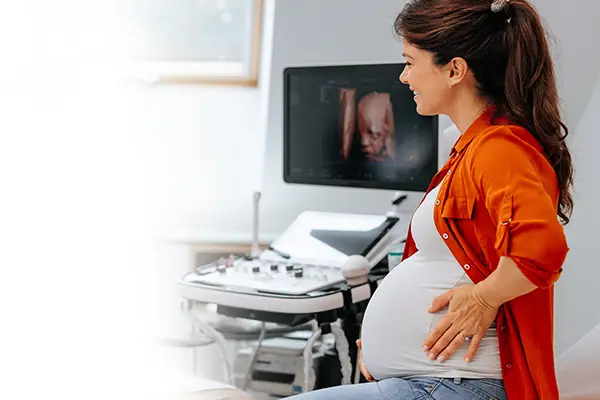
What diseases does the PAPP-A test detect? When should it be performed?
The PAPP-A test (a.k.a. the PAPPA test) is one of the non-invasive prenatal tests designed to determine whether there is a risk of genetic defects in the fetus during the first trimester of pregnancy. These include Down, Patau and Edwards syndromes. It is recommended that the PAPP-A test be performed on every pregnant woman. What does this study consist of and why is it so important? We explain!

How do I calculate what week of pregnancy I am? Why is this important?
How do I calculate what week of pregnancy I am? This is a question every mom-to-be asks herself. Especially when she just received a positive pregnancy test. There are several ways to calculate the age of pregnancy, and thus the expected date of delivery.

Effect of childbirth on the development of the gut microbiota of the newborn baby

CRP test in pregnancy – norms, indications, course
CRP testing in pregnancy is done for early diagnosis of infection. This is a laboratory test that involves drawing a few milliliters of blood and analyzing it. Elevated CRP levels require localizing the focus of inflammation and implementing appropriate treatment.
CRP is a C-reactive protein produced in the liver and fat cells. It belongs to the so-called. acute phase proteins, whose concentration in the body significantly increases or decreases when inflammation occurs. CRP is involved in the immune response by modulating the function of monocytes and granulocytes. Its level is an important indicator when infection is suspected.
Why is a CRP test done in pregnancy?
A referral for a CRP test in pregnancy is given to a woman whose doctor suspects an infection, for example, on the basis of presenting symptoms or abnormal parameters of other laboratory tests. In addition, by determining CRP levels, conditions that threaten the developing fetus can be detected and treated early.
Indications for CRP testing in pregnancy are:
- checking general health,
- Elevated body temperature or fever,
- Genitourinary complaints,
- anemia,
- weight loss,
- liver dysfunction,
- autoimmune diseases,
- Premature departure of fetal waters.
It is worth remembering that based on the level of CRP in pregnancy, it is only possible to determine (or not) the presence of inflammation, but it is not possible to determine its cause or location.
Read also: Lymphocytes in pregnancy – what is the norm? What when they are downgraded?
What does the CRP test look like in pregnancy?
Determination of CRP levels is a very simple laboratory test. The woman should report to the laboratory of her choice, preferably in the morning. The nurse draws a few milliliters of blood from the elbow vein and then submits the secured sample for analysis. CRP testing in pregnancy does not have to be done on an empty stomach. It is advisable for a woman to drink a glass of water a few minutes before going in for a blood draw.
Intense exercise should be avoided before a CRP test in pregnancy, as it can affect the test result. Before entering the laboratory, it is a good idea to sit down and relax for a while.
The result of a CRP test in pregnancy is available the same day or the next business day (depending on the laboratory). It should always be shown to the doctor who ordered the test, as only a specialist can determine further management depending on the level of CRP and the symptoms present.
CRP norms in pregnancy
Normal CRP levels in a healthy person are considered to be below 5 mg/dL, but pregnant women may have slightly higher levels of the protein. The norm for CRP in pregnancy is values below 10 mg/dL. A result above this value is an indication for further diagnostics.
What does elevated CRP in pregnancy mean?
Elevated CRP protein in pregnancy means that there is inflammation going on in the body. Values that do not exceed 40 mg/dL indicate a viral infection or mild bacterial infection. A higher CRP value in pregnancy indicates more serious infections, usually caused by streptococci or staphylococci. The higher the protein concentration, the more severe the condition.
Often, CRP levels reaching triple digits indicate an ongoing cancerous process in the body. Cancer in pregnancy is not common, but it is worth being aware that it is possible. Some women are found to have physiologically elevated CRP during the third trimester of pregnancy. However, its value does not exceed 40 mg/L.
Elevated C-reactive protein requires the introduction of appropriate treatment. The type of therapy is decided by the doctor after additional diagnostic tests. The effects of high CRP in pregnancy can be life-threatening for the fetus. A pending condition in the body can contribute to an intrauterine infection, resulting in a miscarriage or premature birth.
See also: Gestosis and its course and causes